

The ultimate guide to feeding a horse is his/her overall condition. The coat should be shiny and soft. The ribs should be palpable but not visible. The hindquarters and back should be “flat” or smooth across when viewed from behind. A deep crease along the dorsum of the spine along the back usually indicates excessive weight. The lower abdomen and flanks should be round but not excessively so. Some breeds fill out more in this area than others, so abdominal filling is somewhat variable. The type of exercise and the amount of roughage in the diet will also affect the shape of the abdomen. Since adult horses are herbivores, the main component of their diet should always be forage – grass in some form – pasture, hay, hay cubes, or grass-based pelleted feed.
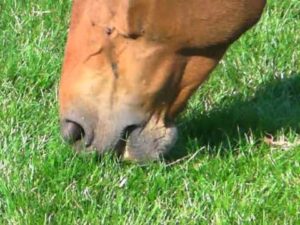 Good quality pasture or hay will maintain many horses in excellent condition throughout their lives. Clean fresh water and a balanced trace mineral/vitamin mix complete a balanced diet for these individuals. Other components are added to balance the diet for each horse based on their specific needs. The age, use, and the current overall condition and health status of each horse determine what additives and how much are needed. The components of the diet that may be manipulated include the total amount fed, the relative amounts of roughage vs. concentrate, the %’s of protein, fat, fiber, and starch, and the vitamin/mineral content.
The total amount fed each day usually varies from 1.5-2.5 % of the horse’s body weight per day. This includes both forage and concentrate. So, a 1000 pound horse would need an average of 2% or 22# of feed per day. However, in some circumstances, it may be as low as 0.5% or as high as 3.0 % of the horse’s body weight. For example, a 1000# horse who is an “easy keeper” may require only 5# (0.5%) of food each day, whereas a mare in early lactation may require more than 25-30# (2.5-3%). The concentrate portion should never exceed 50% of the total amount fed. In fact, it should generally be added in as small amounts as possible. Concentrate is necessary in some cases to provide protein, energy, and sometimes minerals if the forage source is inadequate in these components.
Higher protein levels are required in those horses actually making new tissue. Growing foals, broodmares in late gestation or early lactation, and severely ill or injured individuals need a diet with protein levels greater than that required for a healthy mature adult. Protein is supplied by utilizing high quality hays and adding concentrates to the diet where necessary. Lactating mares and suckling foals require the highest protein levels. Severely injured or very ill horses will also benefit from higher protein levels during the recuperative period.
 The energy provided by a ration is directly related to the number of calories contained in the feed. Energy requirements are increased for all horses in cold weather, in young growing horses, broodmares in late gestation or early lactation, ill or injured horses, and in horses who are worked regularly. Increasing the energy content of the diet simply means increasing the number of calories fed. This can be accomplished by increasing the total amount of hay fed or by adding grain or other supplements to the diet. Vegetable oil can be supplemented to provide a non-carbohydrate source of calories. Up to 2 cups a day may be fed to an adult horse instead of grain.
In cold weather, increased calories are used to maintain body temperature. More food is therefore necessary in the winter to maintain all horses. Interestingly, feeding more hay also helps keep the horse warmer. The fermentation process that breaks down the fibrous portion of roughage is somewhat inefficient, resulting in the production of heat within the colon.
| Amount Fed | % Protein | Total |
|
|
|
|
| Adult horses performing minimal exercise: | 9-10 % | 1.5 – 2% BW |
| Adult horses performing heavy exercise: | 9-10% | 2.0 – 3.0% BW |
| Pregnant mares, last trimester:3 | 14 -16% | 1.5 – 3% BW |
| Early Lactation: | 16% | 2 – 3% BW |
| Older horses, > ~18 yrs.1 | 10-11% | 1.5- 2.5% BW |
| Nursing foals | 16% | Milk/Creep feed2 |
| Weanling foals – 1 year | 14-16% | 2 – 3/3.5% BW |
| 1-3 years | 12-14% | 1.5 – 2.5% BW |
Some breeds which still grow up to 4-5 years of age may require higher protein levels through this period, but usually no more than 12-13%.
1 Older horses
The age at which a horse is considered “old” varies. Late teens or early 20’s is average for many individuals, however, this depends on the overall condition and health. Many older horses continue to perform well into their 20’s. Older horses require slightly higher protein levels and different levels of some vitamins and minerals. Dental and digestive efficiency decreases as well.
To offset these factors, feeds have been designed specifically for geriatric individuals. These are usually complete feeds that are formulated in a specialized pellet that is easily chewed and easily digested if chewing is inadequate. Some horses may eat pelleted rations too quickly and suffer bouts of choke. This can be prevented by softening the pellets into a mash prior to feeding. Feeding smaller meals more often will also improve digestive efficiency in older horses.
2 Foals
Nursing foals should be offered small amounts of grain as early as 2-3 weeks via a creep feeder or in some way that safely prohibits access by the mare. Most foals will begin eating hay or grass with their dams. Foals should be consuming as close to an adequate ration of solid food as possible prior to weaning to avoid weight loss when separated from the mare.
3 Pregnant mares
The weight gain by a growing foal in utero during the first 8 months of gestation is minimal. Nutritional requirements for protein and energy of both mare and foal are readily met by a maintenance ration during this phase. During the last 3 months of gestation, the foal gains approximately 1 pound per day. Some mares will maintain good apparent condition during this time on forages alone, however, other nutrients will be lacking, especially for the foal. The protein, energy, vitamin and mineral content of the mare’s diet must be increased during this time period. Feeds specifically designed for broodmares in late gestation should be used during this time. Lactation requires more energy than any other activity of the horse except racing. Mares produce 3 gallons of milk or more per day of lactation. Milk production peaks at about one month and then gradually declines in volume and nutrient content. By 4-5 months of age, foals will acquire most of their nutritional requirements from solid food.
Exercising horses require increased amounts of energy but rarely increased levels of protein. Frequent, strenuous exercise such as racing or polo may cause enough muscle damage in some horses such that increased dietary protein may be necessary to maintain performance and condition.